
From Newslettering 2 Connecting
how do filmmakers work with festivals in our evolving EcoSystem...

Ted Hope put out a post this week about newsletters and why filmmakers should be running them. Go read it. It’s posts with in the post and full of tips and context. It got me thinking, which is usually what Ted’s writing does.
Here’s where my head went.
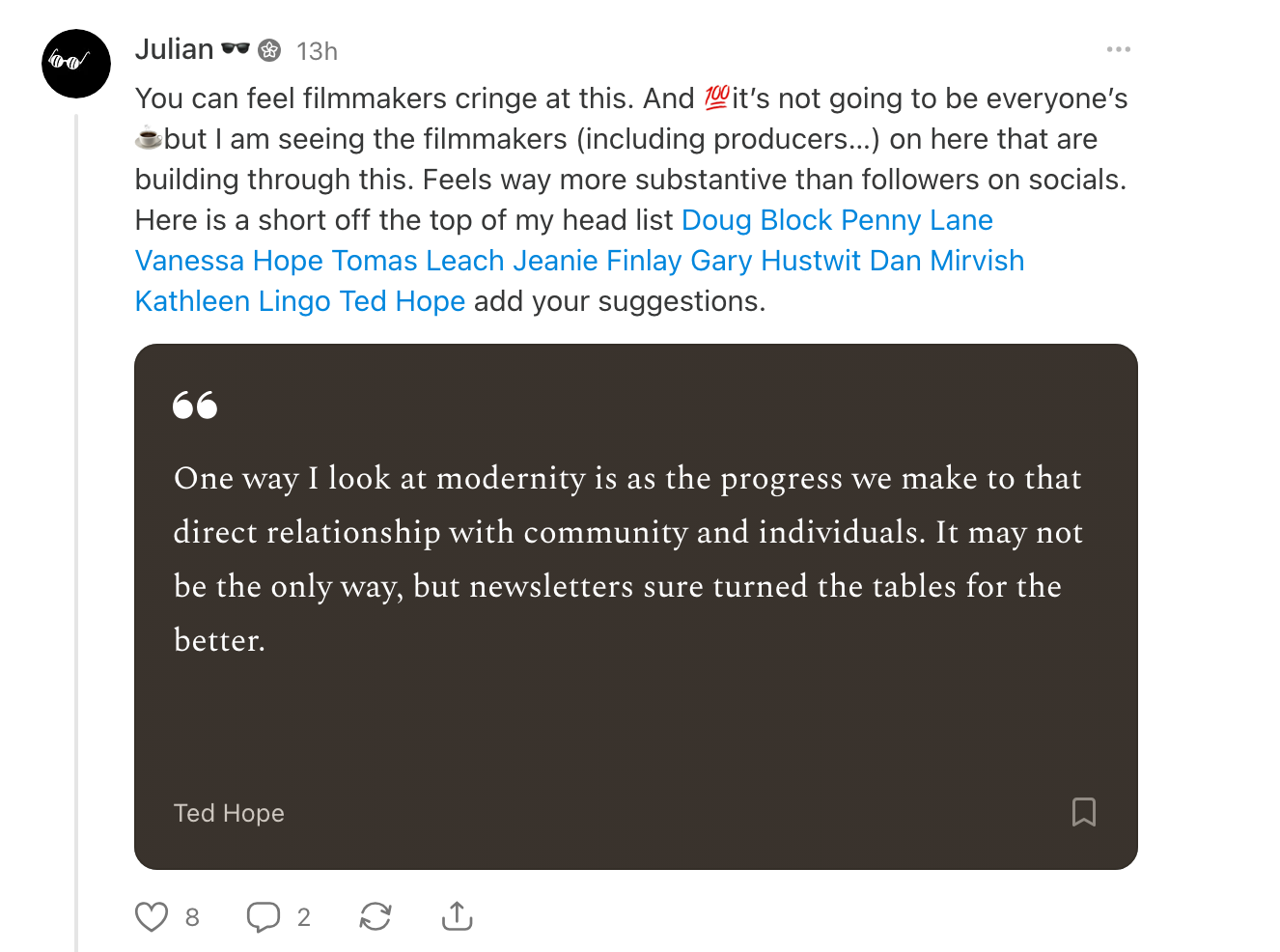
And then I wrote this post.
**Later in the post I’ll share the rest of the exchange Ted and I had from this note above I posted. And the comment from Ted was so connected to my post but he didn’t even know it then.
Connecting with your audience. Musicians figured this out before we (filmmakers) did. When the file sharing thing gutted the business in the late nineties and they had to rebuild, they went looking for tools. And as tools like VHX, Bandcamp, Linktree, showed up, they used them. Built direct connections. Maintained them. And that became a big part of how they survived and thrived. Comedians did the same thing. Built a fan base, kept building it, show by show, city by city, night by night. And then at some point they looked up and thought, wait, why do I need a streamer to put out my special? I can just put it out myself. I have the audience. I have the relationship already. Why am I giving that away?
And there are versions of this everywhere, if you start looking. The craft world did it. Etsy (even eBay) is kind of a version of that, right? People who came up through their craft, potters, knife makers, clothing designers, people who had been making things inside big corporate structures, deciding they could just go out and set up their own thing. er...Food trucks. Reach people directly. Find their people. Build community around what they make. And it worked. Is working.
We can do that. Filmmakers can do that. Filmmakers are doing that. And a newsletter, a Substack, whatever platform works for you, is one of the tools for doing it. So use it. Be open to using it. Try to not think of it as another social media network to get onto. It’s way more then that.
Back to my short exchange with Ted. After my note above he writes.
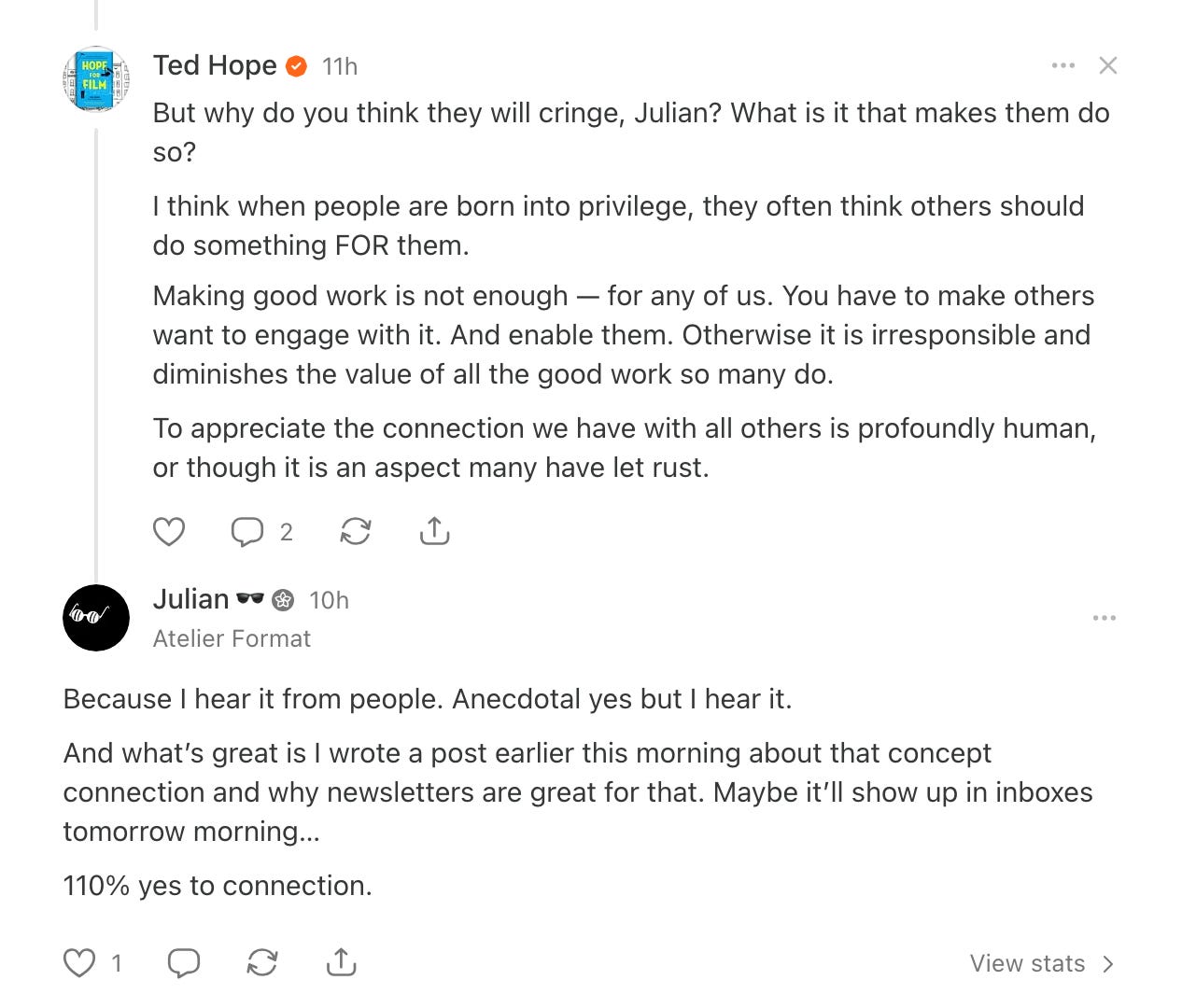
Here’s the thing I keep coming back to. It’s not really about the newsletter. The newsletter is just the vessel. What it’s actually about is connection.
And there’s a version of this that already exists and that we’ve all been doing forever, honestly. You read a book, you listen to a record, you watch a film or a TV show, or even a cat video, and then you tell someone. You message a friend. You bring it up at dinner. You are already, in that moment, using yourself as someone with taste and opinions, sharing with people you think will want to connect with what you connected with. That’s word of mouth. That’s the original viral, the one that’s been around as long as people have been telling each other things. And that’s what direct audience relationships are really about. You’re just doing it at scale, and doing it in a way where the connection can run both ways.
That last part matters. The two-way part. Because so much of being an artist is listening and watching. Seeing the world around you. And building a direct relationship with an audience gives you a way to do exactly that, not just to broadcast into the void, but to actually hear what resonates, what people are thinking about, what they’re carrying around. That’s not a distraction from the work. That can genuinely feed the work. It should feed the work.
Now, I’ll be straight with you about something. I don’t really love writing. Starting from a blank page is not my thing. Never has been. I’m much better at rewriting. Send me your script, your deck, I’ll give you good notes. That’s where I live.
So the idea of writing a newsletter, there was a barrier for me. I had things I wanted to say but I’m not a trained writer, how can I do this...well? I went ahead away because I could see the value and knew I needed to try the thing I didn’t want to do. I started writing and people read it. But I had blocks to maintaining it.
What I discovered, eventually, is that I like to think out loud. I like to dictate. I make a recording with the voice memo app, sometimes quite a long one, honestly, it’s less of a voice note and more of a voice recording, like this one is probably fifteen minutes, and then I get the transcript, make sense of it, and start the process of rewriting from there.
That’s my process. That’s the hack I found for myself.
The blank page problem went away because I stopped starting from a blank page. In my mind the page wasn’t blank, I had the words.
I start from something I’ve already said, and work from that.
And I’m not saying do it my way. Not at all. Maybe you like to draw. Tomas Leach does a lot of journaling and note writing. Maybe you’d drop scribbles into your posts, I actually do that sometimes, little drawings that are how I make sense of something. Taylor Lewis always has visually design-y looking vibe throughout her stack. Maybe you write lists. Maybe it’s just short and punchy. Maybe it’s long (aka Ted Hope) and discursive and wandering. The format is not the point. The connection is the point. Find what works for you and do that thing. Try it Ten times. Consistently. And see what happens.
Last thought. I appreciate the instinct a lot of filmmakers have to protect the work. To keep things quiet until it’s done. To not show anyone anything until it’s finished and polished and ready and then released. I understand that instinct. I’ve had it plenty of times. And there are real reasons for it.
But I want to gently push back on it. Because I think sometimes the reasons we tell ourselves for not wanting to share, not wanting to connect, not wanting to let people in, sometimes those reasons aren’t really about protecting the art. Sometimes it’s just that we haven’t practiced the skill of connecting and sharing as part of the creative process. And it is a skill. It takes practice. Sweat. The first few times you put something out there and it doesn’t land, or doesn’t get the response you hoped for, maybe those people just weren’t the right connection. That doesn’t mean the thing doesn’t work. Maybe the fourth time, the tenth time, the twentieth time, you find the person or the conversation that sparks something you couldn’t have arrived at alone. Maybe not in the moment it happens. Maybe two weeks later, a month later, you’re in the middle of something and a thought from that conversation comes back and suddenly clicks into something useful. Opens a door you didn’t know was there.
Just be open to that possibility. That connecting directly with your audience, before the film is done, while it’s being made, isn’t a compromise of the work. It might actually make the work better than it would have been otherwise.
I don’t drink coffee, I drink tea. But think about your local coffee shop. Knowing the person behind the counter. Them knowing your name. That feeling of walking into a place where you’re known. That’s what we’re talking about. Society was built on that, on communities, on neighbors knowing neighbors, doors open, people helping people. That’s community. And direct audience connection, a newsletter, whatever form it takes for you, that’s just community. Built deliberately. At whatever scale you can manage right now.
And when you put the word “career” in the mix this hits on a whole different level. If you want longevity, you need to build.
So find your tool. Pick up your phone and dictate into it. Draw something. Write a list. Put something out. See what comes back. You’re not selling something. You’re not doing anything icky. You’re connecting. That’s really all it is.
Give it a shot.
Ted Hope’s post The HFF Masterclass: Running A Newsletter is what got me writing today and you can read it here. Worth your time.
Welcome to the new subscribers and followers. If you want to know what this substack is all about, start here and then work through some other older posts like this one and this one. Participate with your comments and suggestions. Share things you like and get your friends to stop by. Here’s another plug for the OG case study post which I’m constantly updating, so send me any case studies I’ve missed that you found useful! I’m in the middle of creating a budget template for direct to audience distribution and looking for you to share with me your data around what you spend your budgets on. DM me! Lastly this past post about audience is a good companion to today’s reading.
Really enjoyed this!