
a crowd-sourced direct to audience budget template pt 1...
...your help needed!

Myself and others have been writing for a while now about audience forward thinking for filmmakers. About NonDē, about what it means to build a direct relationship with your audience rather than waiting for a gatekeeper to hand you one. About why that shift matters and why the time for it is now. Amongst all the thought pieces it also necessary to get practical. I’m heading into the release of my next project using a direct audience approach, and that means actually sitting down and building a budget for it.
And that process led me here.
As I wrote in a previous post about what an audience forward ecosystem looks like
“...the work in this world is not just the singular end product. The work is going to encompass bringing the audience in to your journey making the project.
Which sounds great as a principle. But at some point you have to sit down and figure out what that actually costs and what you’re spending it on.
So I’m working on a budget template for direct to audience distribution and impact campaigns. It’ll have actual line items, built around the things we need to think about when we’re releasing a film this way. I’m building it because I need it. I did a music doc in 2025, it was relatively small scale so I need to expand on what I built for that. I expect to be doing more releases this way so I’m not going to build the budget from scratch each time! AND I want to share it as a resource for anyone who wants it, because this stuff needs to exist in a usable form and mostly it doesn’t.
As I’m working on this I really want your input and to hear from filmmakers in the trenches connecting with audiences. I want to make sure I’m not missing anything. So I made a survey to make it easy to gather info. More on that below.
Direct audience distribution is not new. But the scale of it is different now and the necessity of it feels different too.
You can see it in the films doing it well. Iron Lung. Steal This Film. Films out of Watermelon Pictures. Union. Eno. Hundreds of Beavers. Filmmakers finding their audience, building the release around that relationship, making it work without sitting around waiting for a traditional distributor to ride in. These are not accidents. These are decisions. Strategic ones.
And yet. There’s still a real gap in the how. Like, we can see the results, we can point to the examples, but the mechanics of it, what you actually spend money on, how you think about the sequencing (aka windowing), how you build a budget around your goals rather than just doing it on the fly or copying what you’ve read another film do, that’s still murky for a lot of people. Myself included, honestly. Which is why I think a template is useful.
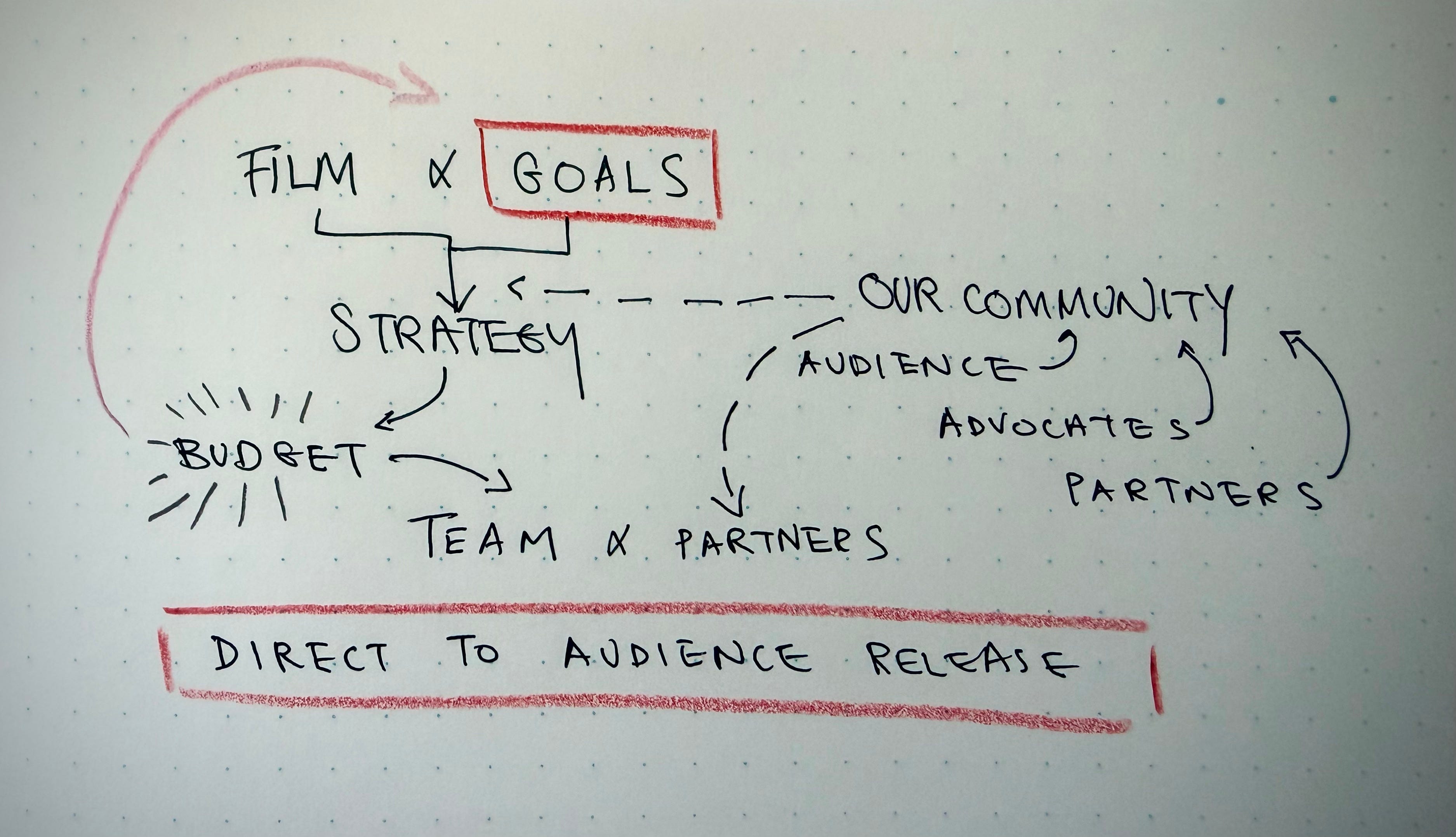
Here’s the thing about a budget template for this kind of release. It’s not just a spreadsheet. Or it shouldn’t be, if I’m doing it right.
The way I’m thinking about it, the template is a catalyst for strategy. You look at all the line items, all the categories, all the things you could potentially put money towards, and it should send you straight back to your goals. Which is where you need to start anyway, before you spend a dollar.
What are you actually trying to achieve with this release? Because that question has a lot of different answers and they lead you to very different places. We all know nothing makes you be sure about your goals more than seeing how much money it’s going to take to achieve them.
Are you trying to recoup investment?
Are you trying to reach as many people as possible?
Is it impact in a specific community?
Are you building momentum that leads eventually to a streaming deal at a higher price point than you’d get walking in cold?
Do you have a companion book, or a course you want to build around the subject matter, somewhere where the real revenue potential sits and the film is doing a different kind of job?
Is it awareness, where eyeballs matter more than revenue right now and a 99 cent rental or even a free watch is actually the right call?
All of these are legitimate goals. There are many more. And each one changes how you’d fill out the budget.
The awards category, for instance, the cost of qualifying runs, the publicity around it, the whole machine, none of that matters if awards aren’t part of your strategy. And that’s completely fine. But you need to know that before you start spending, not after. I wrote about this in this post about awards
Imagine if the money spent four walling for a qualifying run was spent on an impact campaign that reached three or four times the number of people.
The template should also help you think through what the windowing of the release. Windowing is maybe an old word that doesn’t map perfectly onto this new world but the underlying question is the same. What’s the cadence of your release across all the different ways you’re reaching audiences? When do you go wide? When do you hold something back? How does the sequencing support the goals you’ve set? Once you know your goals, and you know how you’re going to put the film out to support those goals, then you can come back to the budget and fill it out in a way that actually means something.
So the template is a tool. But more than that it’s a thinking device. A way to force yourself to get specific about what you’re doing and why. And a way to then think about the cadence of it all.
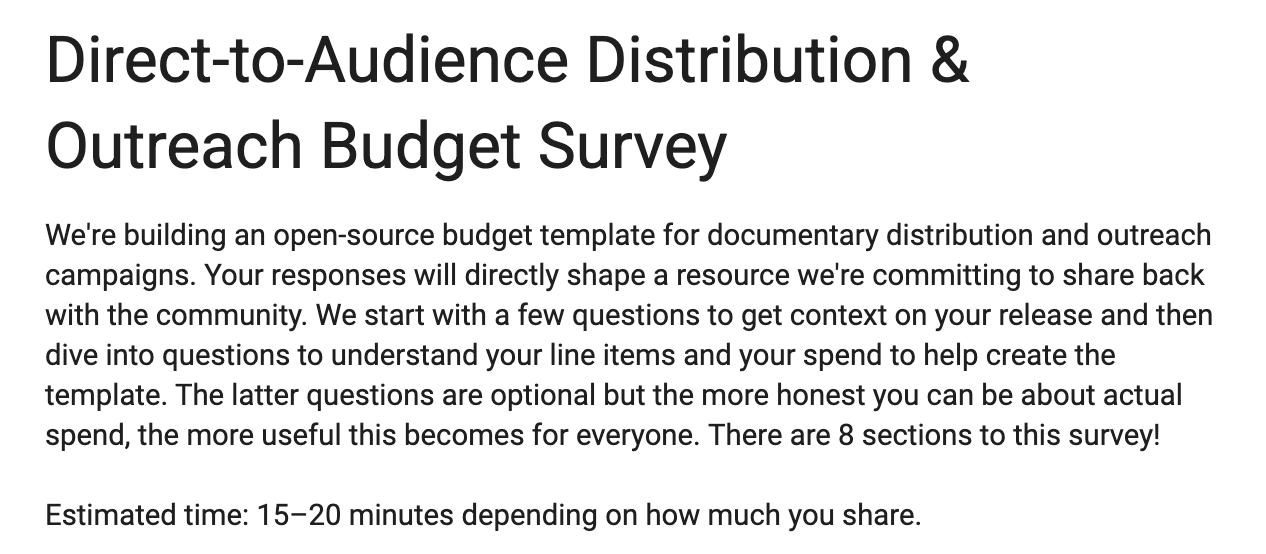
** screenshot from the survey
If you’ve released a film in the last five years using a direct audience approach, or even a hybrid where part of the release was direct and part went through a traditional distributor, I want to hear from you.
I want to know what you actually spent money on. The areas you prioritised. The creative ideas that came out of necessity or inspiration. What worked and what didn’t. And if you’re willing to share rough numbers, even ballpark ones, that’s genuinely valuable. Because the goal eventually is to have enough data to be able to say, okay, if these are your goals, here’s roughly how people have spent money to achieve them. That’s the useful thing. Not just the categories, but some sense of the proportions and the logic behind them.
The survey takes about 15 to 20 minutes. The more people who fill it out the more useful everything becomes, so please share it with anyone you think should be in this conversation.
Take the survey here 👇 that’s how it starts!

A couple of things to flag. The template isn’t just for fiction or nonfiction, it’s set up for both. So some categories won’t be needed but I think it’s still helpful to see it in case it sparks ideas. After the template is done I’ll probably write something about how it applies differently to documentary versus fiction. That’ll be the next piece. Most posts I write tend not to be done without a reference to something Ted Hope wrote so here it is. From his HFF Distribution Planning Template post he listed out 37 collaborators to consider when planning your distribution and those are (mostly) included. In fact read his whole HFF Masterclass: Film Distribution 2026 Edition post. Gold.
If you’ve got thoughts, or things you’d rather not put in a survey, reach out directly. I’m listening.
Welcome to the new subscribers and followers. If you want to know what this substack is all about, start here and then work through some other older posts like this one and this one. Participate with your comments and suggestions. Share things you like and get your friends to stop by. Here’s another plug for the OG case study post which I’m constantly updating, so send me any case studies I’ve missed that you found useful! I’m in the middle of creating a budget template for direct to audience distribution and looking for you to share with me your data around what you spend your budgets on. DM me! Lastly this past post about audience is a good companion to today’s reading.
It wasn't five years ago but back in 2014 I self-released my feature film LAYOVER and learned a lot from the process. Happy to chat or share if it's helpful.